What was once a place thriving with handmade websites, personal blogs, and like-and-follow-free human connection has been reduced to a small collection of a few corporation controlled networks, algorithmically delivering content riddled with ads to maximize profits and keep users scrolling. Especially in the current political climate, it’s no doubt algorithmic social media, government-lobbied news publications, and advertising are the main types of content the average internet user consumes on a daily basis. Personal websites and non-algorithmic social media sites have fallen by the wayside, causing human connection and genuine interactions to be replaced with clout-chasing and trend following.
Compared to the top sites of the 90s and early 2000s, which featured personal website hosts like Geocities or highly customizable social networks like MySpace, it’s almost like the ability to create and share experiences with anyone around the world, one of the core use cases for a system like the internet, has been left behind in decades past. Early internet culture was driven by creativity and community. People made pages because it was fun, a new outlet for self-expression and allowed for discovery of new friends from other countries. Even when social networks started to pop up, like MySpace or early YouTube, discovery was largely manual. Friends linked to each other’s pages, small communities formed webrings to show off similar sites, and posts were shared simply for the act of sharing.
However, as the internet grew, it became clear that there was money to be made. Advertisers realized user’s data and attention could be monetized. Thus, algorithms like FaceBook’s news feed, or YouTube’s recommendation system took off, as predicting what users would click next led to an advertiser-friendly feedback loop. More user engagement means more chances to show users ads, which means more profit, which means more funding put towards optimizing algorithms. Over the years, the internet’s focus on creativity, discovery, and expression has atrophied and shifted towards one of mindless consumption. In recent years, improvements on generative AI have made the process of populating these endless feeds of content even more accessible… just not to actual users. Companies can lazily churn out hundreds of blogs, images, and even videos to be hosted under AI-agent users that don’t even belong to real people. In some cases, these AI users interact with each other, supporting an assertion some are calling "dead internet theory," claiming that the majority of the Internet is made up of bot activity and algorithmically generated content with the purpose of filtering users into advertiser-friendly bubbles.
So… if the internet is dead, what can we do to bring it back?
The solution seems obvious, but being successful at scale looks almost impossible. To break it down a bit, there have been two primary mindsets towards web revival, looking back on what was good, and looking forward to what can be made good.
As for looking back, a notable movement that has seen a recent surge in growth has been the indie web movement. Sites like NeoCities, NekoWeb, and SpaceHey try to bring back the familiar feeling of writing HTML to express yourself on a personal page. These sites take inspiration from the charmingly amateur look of late 90s and early 2000s web design, focusing mainly on basic HTML tags, CSS, and simple JavaScript to create websites and social pages. NeoCities and SpaceHey are inspired heavily by two incredibly influential sites on early web expression, Yahoo’s GeoCities and the social network MySpace, respectively. The sites and pages on these platforms treat the internet how it was nearly three decades ago, sharing pixelated graphics and using dated language in a desperate grasp for a lost culture in Internet history. Forum sites on these platforms such as MelonKing allow users to share sitemaking resources and live in a small bubble where the Internet feels retro. However, is looking back always the solution? While this type of escapism can be comforting for those longing for a more intimate web experience, it also can dampen efforts to move forward.
What’s next for the web is hard to pinpoint, which might be why nostalgia-driven web revival projects have such a passionate audience. Our current trajectory points towards much more artificial intelligence, especially with the wildly impressive growth of OpenAI’s ChatGPT in the past few years. It’s rare that a new site manages to get into the top ten most visited sites alongside tech giants like Google and Facebook. But this AI-driven future isn’t what users seem to want, especially older Gen Z and Millennials who have witnessed the Internet grow over the years. The recent romanticization of 90s and 2000s tech aesthetics and culture shows a bit of a rejection of the AI-powered future offered by corporations. A more user-focused effort can be seen in decentralization, which has taken off in the form of social networks like BlueSky. Rather than user data, posts, and follows being handled by a tech company’s data center, like on Twitter, YouTube, and other popular social networks, BlueSky’s AT Protocol gives users the option to host their data on their own server– or a centralized server of their choice– and give it the ability to engage with other servers that also use ATProto. This open ended, self-hosted approach to user data and the web can be a bit daunting to regular users, but the beauty in BlueSky is it gives the freedom of choice. Users can choose to treat BlueSky like a mainstream social network and have the platform host their data, but always have the choice to migrate away– even onto other ATproto-powered social networks that don’t even connect to BlueSky’s main servers. While other decentralized platforms have tried to enter the mainstream, they tend to have difficulty reaching the average internet user, which BlueSky seems to have somewhat solved with this mixed approach.
With decentralized networks and web revival projects slowly growing mainstream, it feels like the internet is gaining back a small amount of user control. The only missing piece seems to be making these projects accessible to the average user. How can the indie/decentralized web movement reach a mainstream audience?
Wait, what? Here’s where things get a bit abstracted. As an artist, musician, and retro tech enthusiast, I’ve found user reactions to the Internet’s slow corporate takeover very interesting. The combination of old tech-inspired aesthetic trends and small migrations to self-hosted social and webhost networks paint a distinct nostalgia-driven picture of the youth’s desired web landscape. In their longing for a non-algorithmic social Internet, people are coming across projects that aim to invoke nostalgia for a time period they often weren’t even alive for. Aesthetic trends like Y2k, Webcore, and Frutiger Aero draw from 2000s fashion, 90s operating system design, and corporate marketing materials of the 2010s. Oftentimes, the features of the actual concepts these aesthetics are based on are exaggerated, pushing tropes of each to the extreme. The modern retro web sphere is largely a romanticization of what the old web was actually like. Contrasting to the previously mentioned algorithm-driven feedback loop of the mainstream internet, a nostalgia-driven feedback loop abstracts and caricaturizes Internet history into something more comforting and fun for an audience of websurfers who want an escape from the grips of feeds and follows. A new aesthetic, movement, abstract "thing" takes the combined nostalgia of hundreds of thousands of people and creates something new. This "thing" is what I aim to capture with my project, "On3ko."
On3ko is a website, a music artist, a blogger, a voice of the oppressed, a reflection of the self– the synthesis of decades of internet history compressed into one cat shaped… concept. The idea started with discussion of a new music project between me and my friends at Red Panda Studios. We wanted to take the sounds of 2000s pop punk– arguably the defining genre of the old web’s peak time period– and combine it with the relentless unique expression found in modern genres like hyperpop, dariacore, and edm. In many ways, music genres like hyperpop aren’t so dissimilar from early Internet social spheres; they allow for large amounts of self expression while still providing a close-knit enough community to maintain a shared identity.
Of course, along with making music, our project needed to have its own identity as well. We settled on the alias "On3ko," a leetspeak-ified reference to an open-source cross-platform recreation of a virtual pet software called "neko" that was shared, built upon, and redistributed throughout the 90s and 2000s. We replaced the e in oneko with the number 3 as a reference to leetspeak, a popular typing quirk of the Internet. The evolution of the neko software into the public domain felt fitting with the spirit of tech-based self expression we aimed to reach with On3ko.
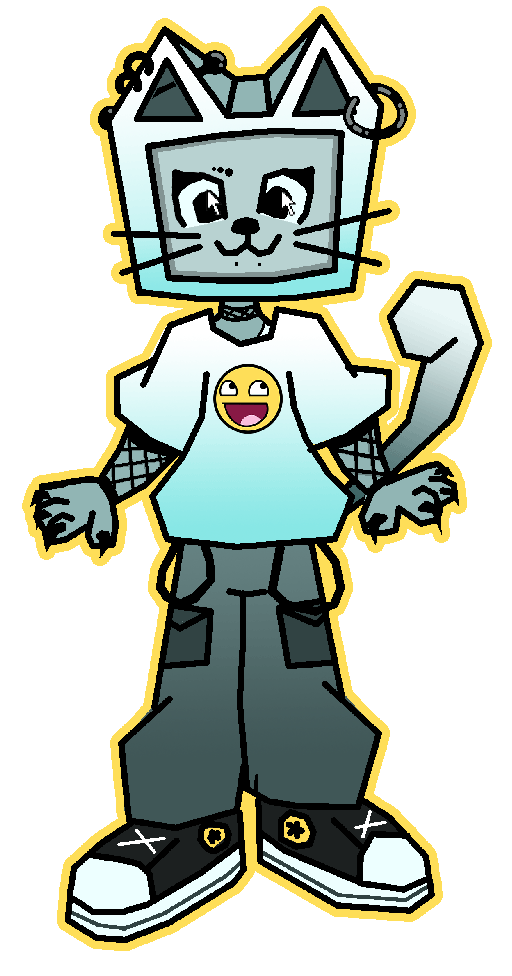
On3ko’s mascot is a genderless figure with a cat-themed CRT monitor as their head. On3ko wears a shirt with the "awesome face" Internet meme on it, and a pair of oversized jeans. Their design aims to reference fashion trends and aesthetics of the 90s to 2010s. Alongside the main On3ko are three other N3kos, each featuring a distinct color and personality. On3ko’s character design is distinct yet simple, perhaps to encourage followers to iterate on the design and make their own n3ko.

Using our name and character I built a website for the project hosted on Neocities under On3ko.lol, borrowing assets from the Windows XP operating system, Winamp music player, and various web graphics repositories. None of the assets ripped from retro interfaces and sites of the past maintain how they "should" look. Instead, they are modified, recolored, and reimagined in a way that feels more like a memory than their actual form. Graphics, fonts, and concepts from different eras of user facing tech are combined together into one idealized interface, echoing the chaotic user-made designs of sites from multiple web eras. The site also features links to On3ko’s music on Soundcloud, a guestbook for visitors to sign, and links to download music via torrent and SoulSeek (a Napster-style file sharing program). The On3ko website is a great way to share our message with the world of the indie web, but how can On3ko branch out further?
Always in the back of our minds when conceptualizing On3ko was the idea of a live performance. Musical performance would bring a whole new dimension to the music, and allow On3ko to interact with real-world internet users. It would also take the voices On3ko draws inspiration from, such as the queer community and furry community, and uplift them more than is sometimes possible on the mainstream Internet. Even online, communities such as these are silenced, sometimes ridiculed for the simple act of expressing themselves. The lessons promoted by the music and overall tone of the project very much point towards being oneself and expressing oneself in individual ways on the internet. A concept that has come to fruition online in the past half-decade or so is "cringe" culture, where posts or actions out of the norm of social media trends are labeled as "cringeworthy" and are ridiculed by other users. Much of the expression in On3ko falls under the umbrella of cringe, including relevant topics such as furry culture and queer culture but also outdated topics like scene kids, emo fashion, or using 1337speak and emoticons such as :3 and xD. Much of these trends have fallen out of fashion and are frowned upon online, even though many users still wish to engage in such culture. This behavior comes about even more thanks to a desire to "fit in" with the rest of a heavily filtered audience. Luckily, these filters don’t exist nearly as much in the real world. For better or for worse, people of vastly differing opinions are able to occupy the same spaces– for example: a music venue! Bringing On3ko to life through a live performance seems like a great opportunity to bring community to internet users offline, and share a message as well.
The foundations for a live On3ko performance were pretty simple: dress up as the characters, and perform music. However, the electronically sequenced method the existing tracks were produced with might not lend itself the best to live music. Figuring out the sweet spot between pre-recorded tracks to live performance seemed important in the production of the show. Doing more stuff pre-recorded also allows for better synced lighting, sound effects, and visuals on the displays of the On3kos’ CRT-monitor heads, and for the ability to put more effort into embodying the characters rather than just stressing about live performance. Alongside these thoughts, I explored many ways to build off the simple idea of a rock concert. What if users could interact with the performers via multimedia installation? Or what if On3ko could give the audience a takeaway that’s something more than just an idea?
At first, the main way I was thinking of Control in relation to On3ko was the contents of the music itself. Since On3ko as a concept exists to critique algorithmic web and control of online spaces by profit-motivated corporations, I was mostly relating control to expanding upon these themes in the music and making sure that they come through to audiences. However, upon discussing a bit more, we also thought in ways On3ko could be "in control." When at a concert, the performer is sort of in control of the audience. What they’re listening to, what visuals they’re seeing, and the types of seeds planted in their heads are mostly controlled by what the band is doing. Thus, we thought of ways to use this dynamic to better convey On3ko’s goals. Having audience interaction, like calling for audience members to go to a certain website, or follow a certain social media account might be effective. We also thought about ways we could give control to the audience. One example we thought of was setting up some sort of retro computer setup for audience members to interact with, where clicking certain desktop icons or typing in a notepad window would affect the visuals on stage.
This card seemed very connected to On3ko, as one of the goals of the project is to get users to delete social media, or use it in more "real" ways. While much of my initial ideation focused on the music and visuals of the show, a call to action or sign up of some kind would absolutely promote an idea of Fellowship and community within audience members. One classmate (Obi) suggested a pin of some kind that labels the wearer as a member of the indie web, or as a fan of the band. Having a more literal call to action after/during the concert would be a good way to keep people thinking about its core messages outside of the actual event.
As discussed earlier in this writeup, expression is one of the most important parts of On3ko. The stage of a concert is a perfect place to spread a message and present culture to an audience of people who may or may not be as familiar with communities such as indie web, the punk fashion and music scene, the furry fandom, or the queer community.
The purpose and ultimate mission of On3ko is to use music, characters, and visuals to invoke an idealized and exaggerated version of the early internet, with the aim to share how interesting the internet can be outside of the filter bubbles we get sucked into online. The target audience for On3ko is mainly young people aged 16 to 25 who use social media and the internet. This is a broad demographic, and while the audience that finds On3ko may be people who are already interested in web revival, it is equally as important to reach people who are actively using mainstream social media, including short form video sites such as Tiktok and Instagram Reels, or other algorithm-driven sites like YouTube or Twitter. I also hope to reach an audience that normally would not enjoy the subject matter or cultures that On3ko draws influence from. For these audience members, On3ko delivers a politically charged message that calls into question their beliefs and assumptions, and more broadly, exposes them to cultures and ideas that they might not normally encounter on the web. A large highlight of the web is diversity, so uplifting a voice that may often go unheard or ridiculed is another goal of On3ko.
From a messaging level to a technical level, the internet is chock full of projects with similar themes to On3ko. I found many existing projects to keep in mind for inspiration of On3ko’s aesthetics, musical style, and technical execution.
LOVEWEB is an animated webseries that provides edutainment content about the tech and culture behind the early internet. It is hosted by an enthusiastic cat named Manon and a My Little Pony inspired unicorn named Cybermare. It aims to teach viewers about niche internet communities and topics from the late 2000s and early 2010s. I greatly enjoy how the language the characters use, the backgrounds of the environments, and imagery in the infographics draw heavily from 2010s internet culture.
Aside from aesthetics, LOVEWEB uses its characters to provide differing viewpoints on many web-related issues. I enjoy the character of Cybermare as a sort of critic / reality check against Manon’s unrelenting nostalgia. Specifically, in the "The Web Has Lost Its Soul" episode, Cybermare provides a rebuttal to Mannon’s promotion of the web revival movement, calling it out as being nostalgia-bait, and suggesting to Manon that escapism isn’t always the answer, and that they need to consider the reform of the tech industry’s relation to capitalism. However, this conversation ends with Manon falling asleep of boredom and tells Cybermare that politics-related discussion in relation to the web revival movement may scare people away. I hope to make the political criticisms more prevalent in my project.
Comparably, the aesthetics, writing style, and character design of LOVEWEB are similar to On3ko. Romanticized versions of Windows 95 are used in the infographics, and retro computing system sounds are used for sound effects. The music of On3ko samples retro computing and games, and also uses a lot of Windows 95-era UI assets in its visual identity as well. Cybermare draws inspiration from the online My Little Pony fandom, and Manon draws inspiration from the Tumblr and 4Chan Anonymous user profiles. Both of these groups are somewhat othered on the web, which is similar to On3ko’s theme of uplifting otherwise ridiculed communities. Contrastingly, LOVEWEB is a little more about teaching the history of the 2000s internet than it is about fixing the current internet. While the aesthetics are very rooted in the tech of the time, the videos are mostly informational essays rather than a call to action or a criticism of modern internet.
Underscores is an electronic music artist whose music is probably the closest to what I want to make for On3ko. Their album "fishmonger" is a really influential inspiration for what I want to make, blending punk rock with hyperpop. It does lean a little more towards "normal" music than I want to do for On3ko. Notably, I really enjoyed hearing underscores do a cover of skater boy in her style. Pop-punk works surprisingly well when combined with more modern hyperpop sounds. I wish I could find more covers like it. Only the fishmonger album uses punk-style electric guitar chords as a main instrument! The rest of underscores’ music is a lot more hyerpop/edm centric. Although, this use of edm stylings and pitched-up hyperpop vocals are also ideas I had in mind for On3ko. I would like the music of On3ko to be a bit more "out there." I would also like to use more nostalgia inducing themes, references, and sounds to give the music a more distinct character.
While the conceptual parts of On3ko are very important, finding out how to construct the CRT monitor heads the characters don is likely to be one of the larger challenges of the project. I tried to find many different types of similar cosplays online, many of which also feature CRT-headed characters. Most of these are TVs, which contrasts a bit to On3ko’s computer monitor head.
The LCD screen works and looks like it fits perfectly in the housing without appearing awkward. Using an iPhone to display the images on screen seems a little clunky, but it seems nice for a mobile setup and doesn’t need any extra cabling plugged in. It would be cool to see a separate mini pc inside the TV that is able to network with another device to keep the contained form factor while also allowing for flexibility in the visuals. The periscope seems like it has really limited visibility, but it does look pretty clean from an outside perspective because it is disguised as a VHS slot. The size of the TV also looks a bit awkward on a human. The LCD screen allowed the creator to put whatever visuals he wanted on the front screen! This would be great for On3ko, because the characters have very expressive illustrated faces. The CRT used for the housing is a TV and not a computer monitor, meaning a little bit more room is available on the inside compared to On3ko’s computer monitor CRT head. This is true for a lot of the TV/Monitor head cosplays I’ve found.
Minbitt’s helmet uses a medium sized RGB LED panel that covers only some of the screen, with a periscope for seeing out. I think the aesthetics of this one are so cute! This looks a lot more like an actual character than just a normal TV slapped on someone’s head. This build uses a microcontroller to control the faces on the LED panel, but they are all pre-programmed in. It would be really nice to be able to connect to it and program in new faces easier, or on the fly in a user friendly way. An issue Minbitt encountered was that the helmet ended up very front heavy, and they had to balance it with a counterweight. If possible, I would almost like On3ko’s head to be a bit disconnected from the user’s, able to move separately a bit almost like a kind of gimbal or gyroscope. Overall, the personification of the TV head into a character is really strong with this build, and fits my goals for On3ko. They are more than just a person with a TV on their head, and I honestly want it to be almost a secondary feature of their personality. First and foremost they’re a relatable, unique character and secondly they have a CRT for a head, not the other way around. Differing from On3ko, the design of Minbitt’s monitor head is very futuristic and sleek. I would want On3ko’s helmet to be a lot more grungy, retro, and used in appearance.
Alttvhead’s helmet uses lined up LED strips for the screen, and has visibility through gaps in between them. I have used programmable RGB LED matrices for other wearable projects, so it was interesting to see them used to emulate a screen. The housing of the TV is also really cool, but unfortunately I don’t really like the look of the flat strips because they don’t really look like the screen of the TV, even if the visibility through the gaps is good. The size of this TV head is very appealing to me. Many of these TV head cosplays seem very top heavy and can tend to look a little awkward. Another cool feature of this one is that the display is controlled by Twitch messages!!! It’s only really being used to show heart emojis, though. I would love to add a bit of audience interaction by maybe allowing users to open pop up windows on On3ko’s face, or poke them with a mouse pointer or something like that.
This TV head was made in a way that allows both the wearer and the audience to see guitar hero gameplay. It was a little difficult to find documentation on its construction, but the creator has been uploading posts showcasing the helmet on instagram. It uses a stereoscopic camera and a simple phone-controlled VR headset to allow the wearer to see outside, with the added benefit of being able to put a virtual heads up display in their vision! This VR passthrough seems to work really well for visibility in this one, as well as the awesome clear TV housing. This route seems to be very promising for On3ko as the wearer is successfully playing a guitar (at least, a guitar hero guitar) from within the headset! This method of visibility seems pretty good for performance, especially if On3ko’s performers would like to see lyrics or chords from within the helmet, with reasonably low latency and off the shelf parts. One thing to keep in mind is that this TV Head is SUPER front heavy. In a lot of the creator’s other videos, they had to use a neck pillow to keep it propped up. Some commenters suggested a kind of shoulder mount to keep pressure off their head.
One artist that came to mind when thinking of the mashup of pre-recorded music and live music is Porter Robinson. Porter’s recent album tour, SMILE :D, employed a live band for backing tracks with smaller parts sequenced, while his prior album tour Nurture featured just Porter on stage, jumping between different instrument parts while singing into a pitch shifted vocal processing chain. Both types of performance are something I had in mind for On3ko, swapping between different synthesizers and DJ equipment while having heavily processed vocals. I would like to do something in between the two Porter shows, with a live band AND pre-recorded tracks as the main focus. DJing or playing along with pre-recorded tracks would allow On3ko to share music of the time that would be harder to play live, such as nightcore or happy hardcore. I was always curious to see how they sequenced out the different songs, and handled the swapping between instruments. During my research, I discovered they had a behind the scenes video, but unfortunately this video didn’t supply much technical information about how the show was put on.